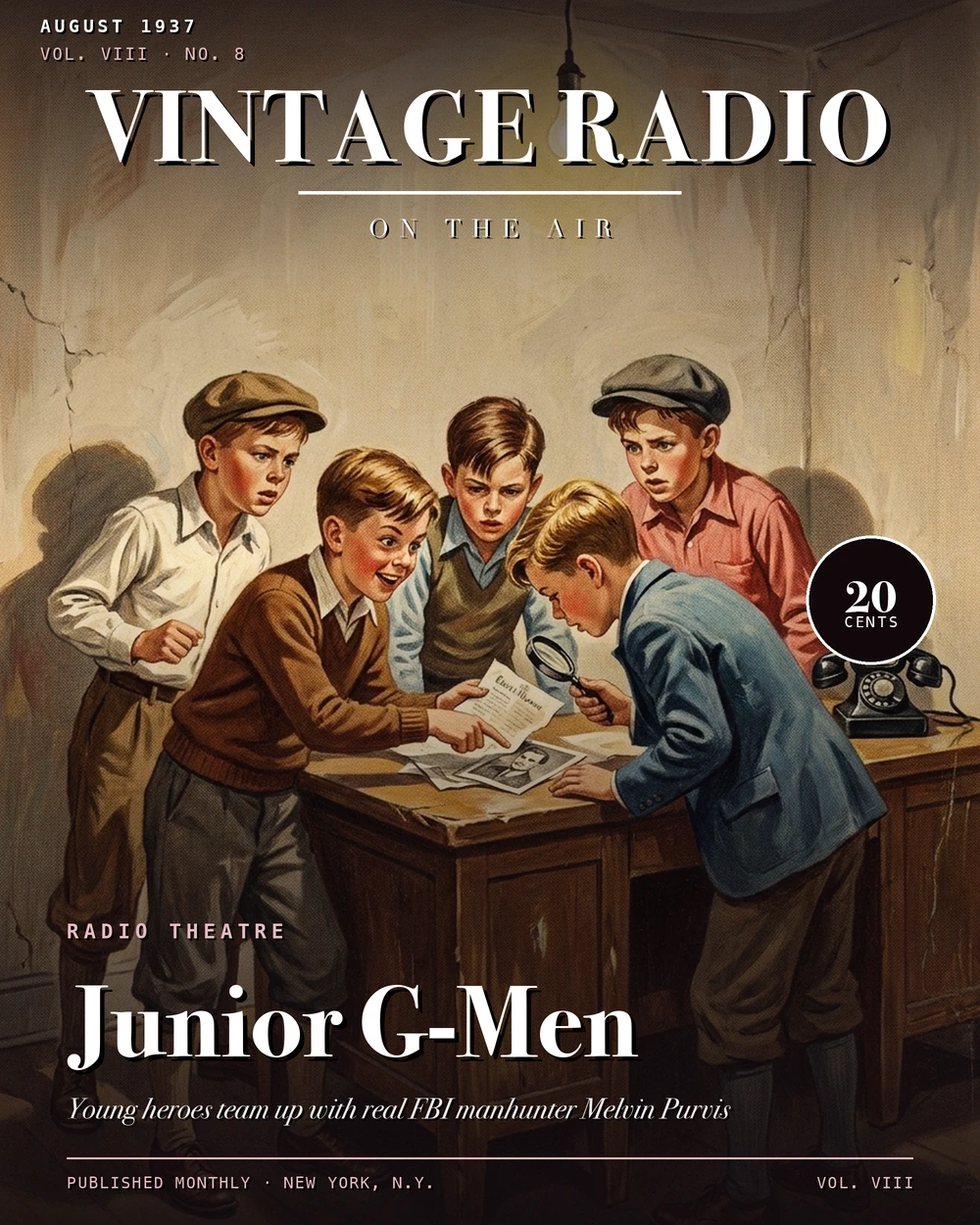
Junior G-Men
The Man Behind the Microphone
Most adventure radio shows aimed at kids leaned on fictional heroes — invented lawmen, made-up detectives, characters who existed only in the imagination of a writing room. Junior G-Men took a different approach. The show's host was Melvin Purvis, and Purvis didn't need a scriptwriter to make him sound dangerous. In 1934 alone, he had led the FBI manhunts that ended in the deaths of John Dillinger, Pretty Boy Floyd, and Baby Face Nelson. By the time he resigned from the Bureau in July 1935, a Literary Digest poll had ranked him the second most famous person in America, behind only Franklin D. Roosevelt. Contemporaries compared him to Dick Tracy — except Purvis was real.
That authenticity was the whole point. The True Adventures of Junior G-Men, which premiered on the Mutual network on March 1, 1936, and ran through March 18, 1938, built its appeal around the idea that kids were getting crime-fighting advice from someone who had actually done it. Purvis's name on the program gave it a weight that no fictional hero could match, and the sponsors — Fischer Baking Company and Post Toasties, the latter a General Foods brand — understood exactly what they were buying.
How the Show Was Built
The format was straightforward: a boy and his chums team up to fight crime, working their way through tight, suspenseful plots that drew directly on Purvis's FBI background for color and authority. Episodes were structured around cliffhangers, with the story cut at a moment of maximum tension to pull listeners back the next time. The catalog of surviving episodes includes multi-part story arcs — "The Missing Witness," "The League of One-Legged Men," "The Man Who Laughed" — alongside single-episode outings like "The Mail Robbery," "The Man on the Inside," "The Man Who Talked Too Much," and "The Man With the Scarred Chin." These titles have the pulpy energy of the era: short, punchy, promising something lurking just around the corner.
Production relied on the tools radio adventure always did — catchy theme music, sound effects that put the listener in the middle of the action, and plots that moved fast enough to keep young imaginations locked in. The show worked espionage and crime-fighting into stories pitched at an audience that wanted to feel like participants rather than bystanders. That last part mattered more than it might sound.
The Club That Rivaled the Boy Scouts
What made Junior G-Men unusual — even among the premium-heavy world of children's radio — was the scale of the organization it spawned. Listeners could join the Junior G-Men Corps, and joining meant something tangible: badges, secret operators manuals, passwords, codes, cap pistols, and a real sense of membership in something larger than themselves. The club was promoted directly through Post Toasties cereal boxes, with premiums available via box tops — a promotional loop that tied breakfast tables to the radio dial and back again.
By any measure, the response was extraordinary. The Junior G-Men Corps reportedly enrolled 260,000 children across the United States, a number said to rival the Boy Scouts. The club's motto — "It's easier to build boys than to mend men" — tells you something about how seriously the adults behind the program took their side of the bargain. Police departments and non-profit organizations lent support, seeing Junior G-Men clubs as a practical tool against juvenile delinquency. This wasn't just a cereal premium operation; it was positioned as a civic project.
The key distinction from most G-Men media of the period was intentional. Movies, comic strips, pulp books, and other radio programs in the broader FBI-encouraged "war on crime" campaign generally centered adult heroes even when marketing to children. Junior G-Men put boys at the center of the action. The show was designed to give its audience a sense of participating in the adult world of crime-fighting, not just watching from a safe distance.
The Wider Cultural Moment
The show existed inside a deliberate media ecosystem. J. Edgar Hoover's FBI had been actively encouraging and shaping a wave of "war on crime" content — movies, comic books, radio programs, pulp novels — in the years before World War II. Junior G-Men fit squarely into that campaign, and Purvis's personal fame made him a natural figurehead. The arrangement carried its own tensions: Purvis had walked away from the Bureau in 1935, and the kind of public celebrity he carried into radio was exactly the kind Hoover tended to resent. But the Junior G-Men concept aligned with the broader message the FBI wanted to promote, and Purvis's contract with General Foods turned that alignment into a national children's club.
The show also generated reach beyond radio. A book, Junior 'G' Men's Own Mystery Stories, was published in 1936. A "big little book" followed in 1937. The concept eventually made it to the screen in a 1940 Universal film serial starring the Dead End Kids — Billy Halop and Huntz Hall among them — alongside the Little Tough Guys, with two further serials following: Junior G-Men of the Air in 1942 and additional entries featuring the same cast. For a radio show that ran just over two years, the cultural footprint was considerable.
What Survives
The catalog holds 52 episodes, enough to follow the shape of the series across its run and get a real sense of how it moved between single-installment cases and the longer multi-part arcs. The cliffhanger structure that kept audiences coming back holds up as a piece of craft — the writers knew exactly when to cut, and the surviving episodes show why the format worked on young listeners with the energy and patience for serialized stakes.
Junior G-Men represented something specific about what radio could do in the mid-1930s: collapse the distance between a national celebrity, a cereal box, and a ten-year-old's imagination until they felt like one continuous thing. The show didn't just ask listeners to admire Melvin Purvis from a distance. It handed them a badge and told them they were part of the outfit.